
TOGETHER FOR A SUSTAINABLE ENERGY FUTURE
A sustainable energy future needs the right infrastructure. That is why Primeo Energie develops, builds and operates heat networks and makes long-term investments in a reliable and future-oriented heat supply. We combine energy, expertise and modern technologies while increasingly using regional and renewable energy sources – for a sustainable heat supply for tomorrow.
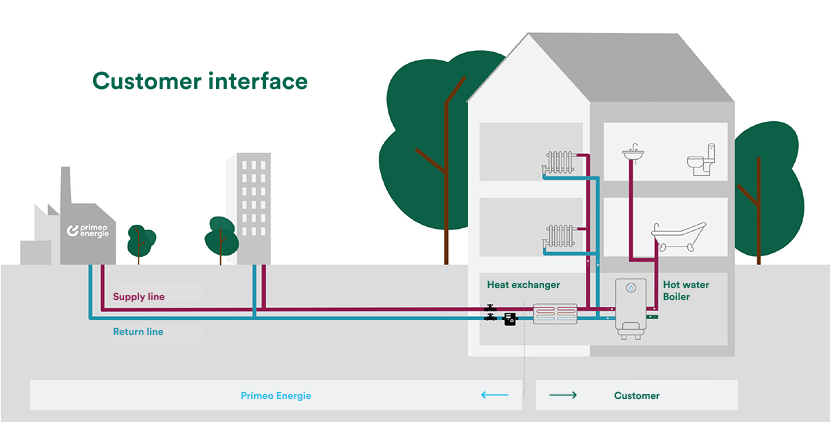
How district heating works
District heating is generated centrally within a heat network and transported to your building via a network of pipes. A compact transfer station in your building provides the interface between the district heating network and your building’s heating system. A heat exchanger transfers the heat to your heating system, where it is used for space heating and hot water.
- Heat generation
Heat is generated within the heat network and distributed via the district heating network. - Transfer station – your interface with the heat network
The compact transfer station transfers heat from the district heating network to your building’s heating system. - Heating & hot water
The transferred heat is available for space heating and hot water production.
Your benefits
High level of comfort
Heat for space heating and hot water is available whenever you need it – conveniently and reliably.
Sustainable heat
Depending on the heat network, regional and renewable energy sources are used. Heat generation produces no direct air or noise emissions at the building.
Less hassle, more space
You no longer need to worry about generating your own heat. Burner servicing, tank cleaning, chimney sweeping and emissions measurements are no longer required.
Regional & reliable
Heat is generated locally. This strengthens regional value creation and contributes to a secure heat supply.
Predictable costs
Your heat prices are contractually defined and transparently structured. This provides a reliable basis for planning your heating costs.
Comprehensive support
The heating system is monitored around the clock. In the event of a fault, our 24-hour emergency service is automatically notified and takes care of resolving the issue.
Five steps to district heating
Connecting to district heating is straightforward: from your initial enquiry and personal consultation through to commissioning, we guide you every step of the way. We assess your building’s technical requirements and the options for connecting it to the district heating network.
Check availability
Check online whether district heating is available at your address and submit an enquiry if you are interested.
Consultation & assessment
Together, we assess your heating requirements, the conditions on site and the technical requirements for a connection.
Receive an offer
Based on our assessment, you will receive an individual offer for your district heating connection.
Sign the contract
You choose district heating, and once the contract is signed, we can proceed with the planning and implementation of your connection.
Connection & commissioning
We plan and coordinate the implementation of your district heating connection. Once commissioned, your building is supplied with district heating.

Funding options for your district heating connection
Various funding options may be available for connecting to a heat network. Find out more about the Primeo Energy Fund as well as cantonal, municipal and regional funding programmes.
District heating in your municipality
Arbon
Biel-Benken
Dornach
Einsiedeln
Gempen
Grenchen
Hombrechtikon
Lenzburg
Niedergösgen
Oberwil
Oftringen
Rheinfelden
Rothrist
Schönenwerd
Stansstad
Steinach
Therwil
Zofingen
Frequently asked questions (FAQs)
Our address checker allows you to quickly and easily find out whether your property can already be connected or is located within a planned expansion area.
The cost depends on factors including the required connection capacity, the distance from the main pipeline and the structural conditions on site. We will be happy to provide you with an individual offer.
Yes. When connecting to a heat network, the existing heating solution is generally replaced by a compact heat transfer station.
District heating provides a sustainable, convenient and space-saving heat supply. You no longer need your own heat generation system and benefit from a reliable regional energy supply.
Different sustainable energy sources are used depending on the heat network – for example, waste heat, wood energy, environmental heat or heat pump systems.
Our heat networks are professionally operated and monitored. Modern infrastructure and redundant systems ensure a high level of supply security.
The connection process consists of several steps:
- Address check
- Personal consultation
- Individual offer
- Planning and implementation
- Connection and commissioning
The timeframe depends on the scope of the project and the development status of the respective heat network. Following the technical assessment, we provide you with transparent information about the next steps and the anticipated schedule.
Yes. Existing heat networks are being expanded in various regions, while new areas are also being assessed. You can find out more by using our address checker or contacting us directly.
No. Information regarding future expansion areas or potential connection dates is provided for guidance only and represents non-binding planning targets. Plans may change due to technical, economic or regulatory circumstances.
Technical documents, forms and further information about district heating connections are available in the Professional section.
Depending on the location, type of building and current legislation, funding programmes or financial support may be available. We will be happy to help you identify potential funding opportunities and provide information about available programmes.
The heat price generally consists of several components:
- Base price
This covers, among other things, the provision of infrastructure and the agreed connection capacity. - Energy price
This is based on your property’s actual heat consumption. - One-off connection fee
This depends on the connection capacity, location and structural conditions.
The exact pricing structure depends on the respective heat network and is clearly detailed in your individual offer.
Part of the heat price may be linked to economic factors such as energy prices or national indices. This ensures that price developments remain transparent and traceable over the long term.
The connection fee generally covers the infrastructure required to reach the property, the network connection and integration into the heat network. The exact scope is defined individually for each project.
Depending on the heat network, minimum capacity requirements or minimum charges may apply for the provision of heat. Details are clearly stated in your individual offer.