
Local Electricity Community
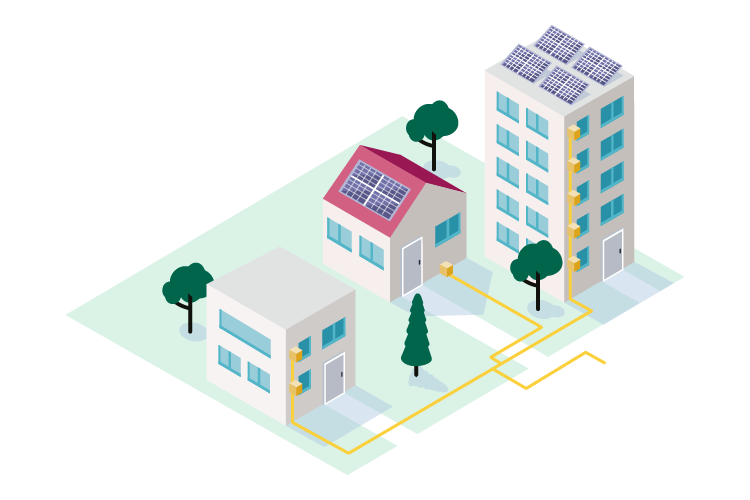
How does a local electricity community (LEC) work?
With a legal entity, electricity from energy generation plants, such as a photovoltaic system, can be distributed to third parties (end consumers) via the local distribution grid .

The advantages of a LEC
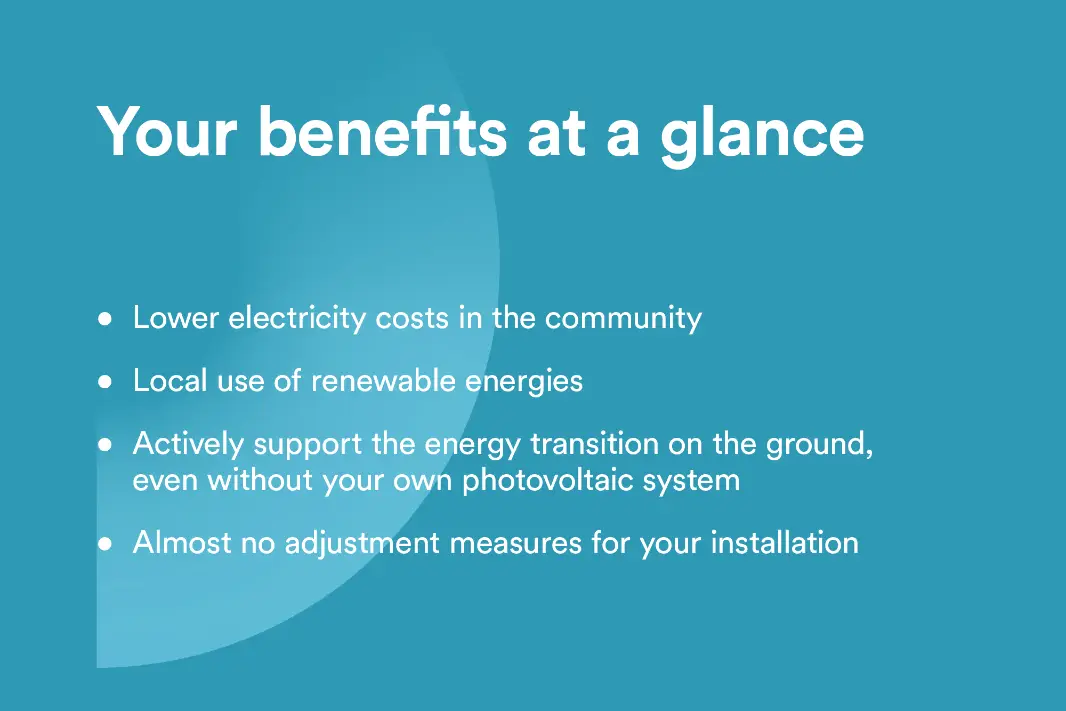
- With a LEC, the self-produced electricity from the energy generation system can be distributed to third parties using the existing local distribution grid.
- The electricity not consumed by the owner of the energy generation system does not necessarily have to be returned to a grid operator, but can first be used in the LEC.
- Your roof is unsuitable for a photovoltaic system or you don't have the option of installing one? But you still want to use local, renewable electricity? This is no longer a problem with participation in a LEC.
- You will continue to receive a bill from Primeo Energie. A service provider may need to be called in only for the LEC electricity, i.e. the electricity sold in the community.
- For the amount of «LEC electricity», i.e. self-generated electricity that is distributed in the community, there is a reduction on the tariffs for using the electricity grid.
- This ‘LEC electricity’ or ‘internal electricity’ can be sold to participants within the LEC. There are no requirements with regard to pricing; this can be agreed by the LEC participants in compliance with civil law.
- Thanks to the use of the facilities of the local distribution grid operator, no major adjustments to the metering equipment are necessary. It is important that a smart meter is installed.
Your discount on the grid fee
Use our map to find out which other participants are eligible for LEC. To do so, enter your place of residence and your address. Depending on the discount amount you select, the tool will show you which participants (green dots) could join your LEC with the desired discount.
Please note: The map only covers the Primeo Energie supply area.
When purchasing LEG electricity, participants benefit from the following reduced grid usage tariff:
- High discount: 40 per cent if the LEC electricity can be used without transformation levels
- Low discount: 20 per cent if transformation is required
- The ‘LEC map query’ provides an overview of the buildings that could be eligible for a local electricity community (LEC) with either a high or low discount based on the network topology. It is non-binding and provided without guarantee. Binding information on the network topology with regard to a possible LEC at a specific location can be requested using the contact form provided on the Primeo Energie website.
- In addition to the network topology requirements, the formation of a LEC requires that the share of production accounts for at least 5 per cent of the connected load of the participating parties.
- A final review of all LEC requirements will only take place after it has been reported to Primeo Energie. Primeo Energie reserves the right to reject the feasibility of an LEC despite a contrary map query if the requirements are not met at the time of the review.

Instructions for registering with LEC
Please note that you are only legally permitted to add metering points that are connected to the same substation (zone).
During this time, no further LEC participants can be added or removed. Furthermore, SmartMeters will be installed if necessary.
Frequently asked questions
- Grid area: All participants in a distribution grid level must be in the same grid area.
- Grid levels: The distribution grid is divided into different grid levels. Only grid levels 7 (NE7 – usually commercial, small industry and households) and 5 (NE5 – usually industry) may be used to form a LEG.
All participants must be at the same grid level. This means that a mixture of grid levels within a LEG is not possible. - Municipality: A local energy group
- Capacity ratio: The minimum capacity of all generation plants in relation to the connected loads of all participating end users is 5 per cent.
Any natural or legal person can join forces with another to form a legal entity. This means that consumers, prosumers, operators of renewable energy systems and storage operators can form a legal entity, provided that they comply with the applicable laws and ordinances.
As with a merger for own consumption (PCA), you don't have to worry about this with a LEC either. The community's surplus energy can be sold on the electricity market or simply given to the distribution system operator (the current tariffs of the respective customer apply).
Yes, that is possible. The surplus energy from the PCA/vPCA is then made available to the LEC. Any remaining energy is fed into the distribution network as before.
Register your LEC via your myPrimeo customer portal. Service providers without a customer portal can open an account on the myPrimeo customer portal and register the LEC.
- Administrative hurdles: Setting up a LEC or similar communities requires legal and administrative preparations. For example, written communication between participants is required by law.
- Financial burden: Initial investments in generation and storage facilities can be high. However, possible contracting solutions can help here.
- Complex billing: Billing for electricity consumption within the community (LEG electricity) can be organisationally demanding.
The establishment and operation of a LEC is free of charge.
Please note that the metering costs shown on the invoice since 1 January 2026 are presented independently of LEC (RCA/vRCA).
Yes. Participants may terminate their participation at the end of the month by giving one month's notice to the distribution network operator and in compliance with the deadlines specified in the contract with LEC.
Yes, the distribution network operator may change the network topology as part of its normal network planning and security activities.