Virtual private consumption association
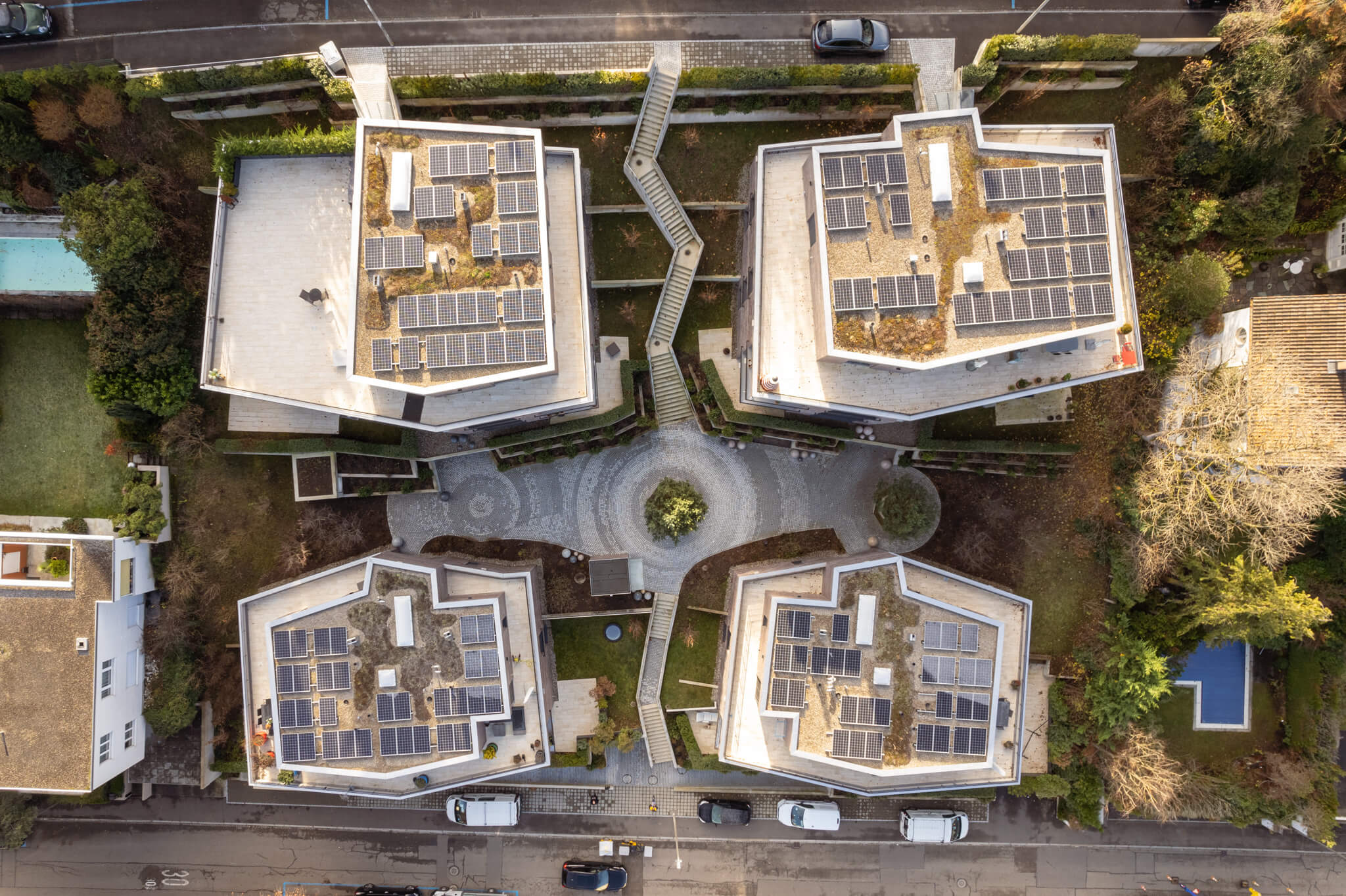
A virtual aggregation for own consumption (vPCA) is an extension of the classic PCA model. A vPCA has been possible since the beginning of 2025. The key difference here is that the participants do not need to have the same main connection point, but rather a shared connection point (e.g. a distribution box). This means that a vPCA can be implemented both within an existing building and across several neighbouring buildings without the need for physical modifications to existing installations (such as cables or meters).
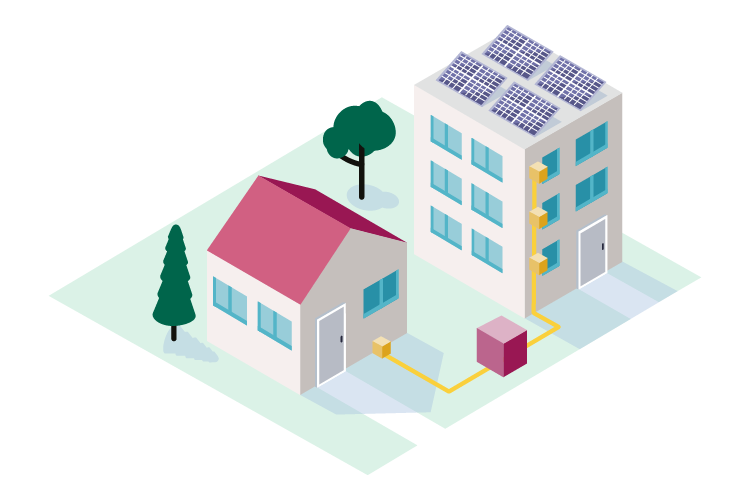
How does a PCA work?
In a virtual private consumption association (vPCA), participants are virtually aggregated.
The electricity they generate is distributed within the pool. Any surplus electricity is fed into the grid and remunerated to the vPCA representative. Conversely, additional electricity is purchased from the energy supplier as required. The members of a vPCA act as a single customer vis-à-vis the distribution system operator.
Consumption is measured using the network operator's existing smart meters, which record the electricity consumption of the individual participants. The measured data is made available to the vPCA operator by the distribution network operator.
The vPCA representative is responsible for billing all participants in the vPCA for their electricity consumption. The representative may be a private individual (e.g. the owner) or an investor and is responsible for communication with the grid operator and the billing logic. A service provider may also be commissioned to prepare the consumption data and handle billing.
Will a vZEV work for me?
- All participants must be connected to the grid via a common node.
- The production of sustainable electricity must cover at least 10 percent of consumption.
- The energy generation plant (usually a PV system) must already be in operation and have been approved by Primeo Energie.
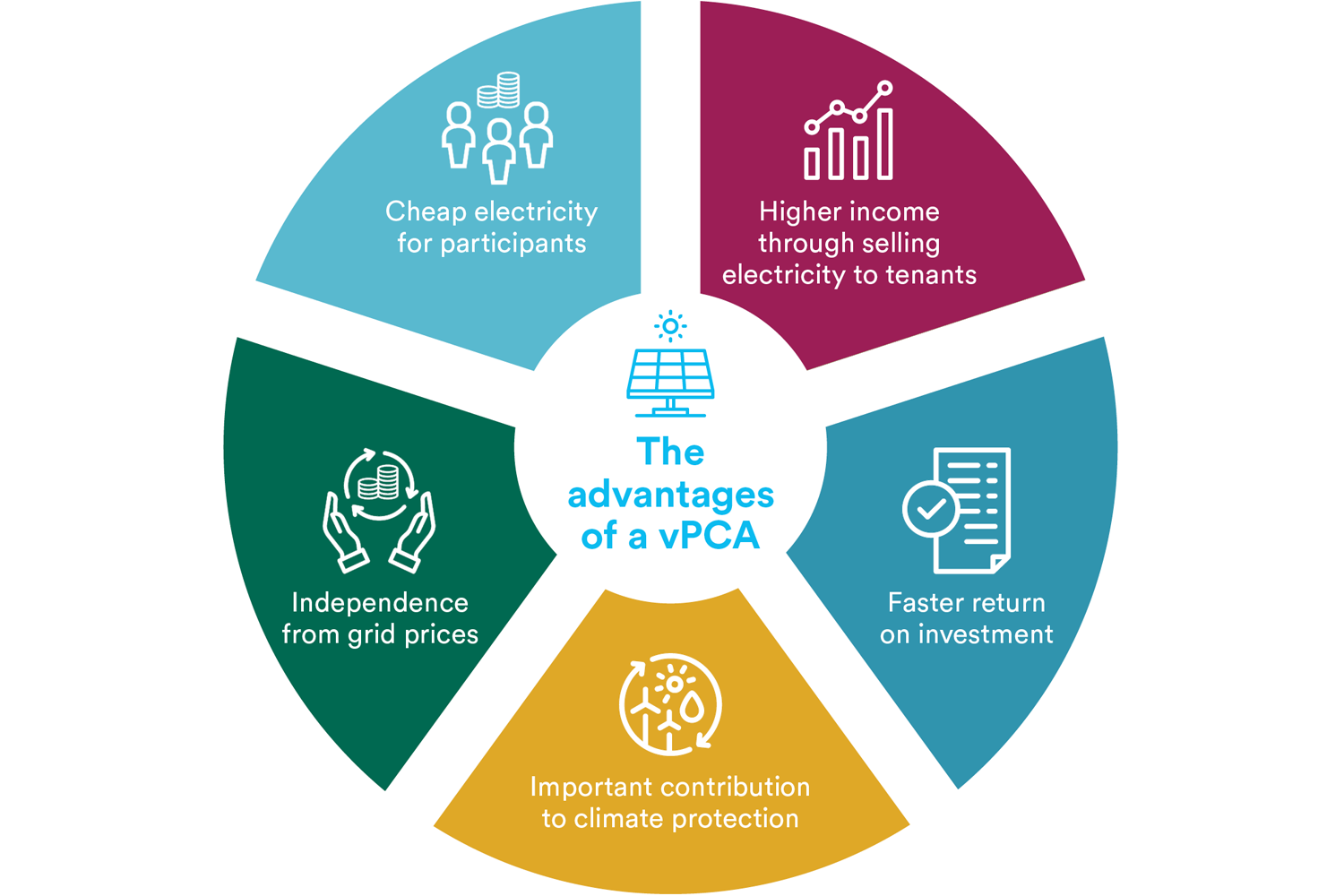
The advantages of a PCA
Similar to the classic PCA, the virtual association is beneficial for all parties and increases the attractiveness of residential and commercial properties in many ways:
- Since you can sell the locally produced electricity to other participants at a higher rate than feeding it back into the grid, your investment pays for itself more quickly. You are less dependent on any future reductions in feed-in tariffs.
- Unlike traditional PCAs, no adjustments to the metering infrastructure are usually necessary.
- Participants in the vPCA benefit from lower (solar power) prices compared to purchasing electricity from the grid alone. This makes your property more attractive.
- In addition, the ecological and sustainable supply of electricity from your own roof is an important contribution to climate protection.

Our full-spectrum PCA service
We support you in planning, establishing and managing your self-consumption community and take care of everything for you, from consulting and operation to billing.
What sets us apart:
- High level of expertise: Energy industry expertise, 50 years of experience in site development, access to an extensive pool of specialist consultants
- Comprehensive range of services: Data measurement and storage, real-time visualisations, billing service (including customer service)
- Additional services: Electric mobility, charging and sharing solutions (e-cars, e-bikes, e-scooters), battery storage, HVAC measurement and billing services
- Economic support: Attractive financing options and additional income
Self Service Abrechnung mit Primeo EasyBill
Verwalten Sie bereits einen vZEV oder möchten Sie einen vZEV selbst abrechnen? Mit Primeo EasyBill erstellen Sie für kleinere vZEV schnell und unkompliziert Ihre Abrechnungen selbst.
Erfahren Sie mehr – starten Sie jetzt mit unserem Service!
References
Frequently asked questions
The key difference between traditional self-consumption and vPCA lies in shared use: instead of each residential unit or party obtaining its electricity separately from the grid operator and being billed accordingly, the individual grid connection points are merged ‘in the background’ (and thus virtually) to form a virtual shared grid connection point and treated as a shared connection. The solar power produced is billed internally and the remaining electricity demand is covered by the public grid.
- The participants have a common grid connection point/connection point; sleeve networks do not generally allow vPCA.
- The production output of all energy generation systems (EEA) must be at least 10 percent of the connected load of all participants.
- For participating PVAs, the registration process must be completed in accordance with the «10 Schritte zu Ihrer PVA» (only in German) up to and including point 7.
- Virtual PCAs can also only be established at low voltage level (voltage level below 1 kV).
- The energy generation plant is not included in the subsidy model with a high one-off payment (HEIV) at Pronovo AG (HEIV – Pronovo AG).
- If an energy generation plant with direct feed-in is integrated, it must not be included in the subsidy model with cost-covering feed-in remuneration (KEV) at Pronovo AG (Facts EVS – Pronovo AG).
- Management of the merger: Coordination of participants, communication with network operators
- Measurement and billing: You ensure transparent billing – either organised yourself, with the help of digital platforms or with a service provider such as Primeo Energie.
- Establishing a contractual basis: You define the rules within the vPCA – for example, on electricity distribution, pricing, operating costs or refunds for surplus production.
- Legal situation: You ensure that all requirements for grid connection points, measurement technology and legislation (e.g. EnV, EnG, StromVV) are met.
- Registration with the grid operator: You register the vPCA with the distribution grid operator.
The network operator operates the metering infrastructure within the vZEV. It measures the electricity consumed and provides the metering data to the vZEV representative.
The billing that you, as the representative, are required to carry out can therefore be a challenge. Alternatively, service providers are available for these tasks (e.g. online self-service portals or Primeo Energie).
You pay a monthly fee for the virtual main measurement by the distribution network operator, and the measurements of the individual participants are also invoiced.
A simple calculation example:
Assuming you can sell your solar power to participants at 23 pence per kWh and the feed-in tariff to the grid is 13 pence per kWh, you achieve a benefit of 10 pence per kWh.
If you are able to sell 20 megawatt hours of electricity within the vPCA, your benefit is £2,000 (20,000 kWh x 10 pence/kWh).
The greater your production and sales, the more profitable the vPCA can be operated.
No. The members of a vPCA act as a single customer vis-à-vis the distribution network operator. This means that the electricity bill is also issued on the basis of a single (virtual) metering point and there is only one bill. This is invoiced to the legal representative of the association. The electricity costs are then settled independently within the community.
What to do with excess solar power from your own photovoltaic system? With vPCA, you don't have to worry about that: if you don't want to sell the energy you don't need yourself on the electricity market, the distribution network operator will take it off your hands and pay you for it – they are obliged to do so.
The term itself explains what characterises own consumption: according to Article 16 of the Energy Act (EnG), the energy generated by the owner must be used by the owner of the system or made available directly on site to other consumers. As soon as the grid operator's grid is connected between the system and the consumers, it is no longer considered own consumption.
There are various consumption scenarios:
- The system produces exactly as much energy as is needed during the same period. Additional energy from the grid is not fed in.
- The system generates more energy than is currently needed. This can then either be stored or fed into the grid. The feed-in is remunerated by the grid operator accordingly.
- The system generates less electricity than is currently needed. In this case, energy can be taken from the storage system or obtained from the grid.
Yes. Private consumption is possible in conjunction with photovoltaics, biomass, and wind installations – regardless of the size of the respective production facility.
Yes, the distribution network operator may change the network topology as part of its normal network planning and security activities.